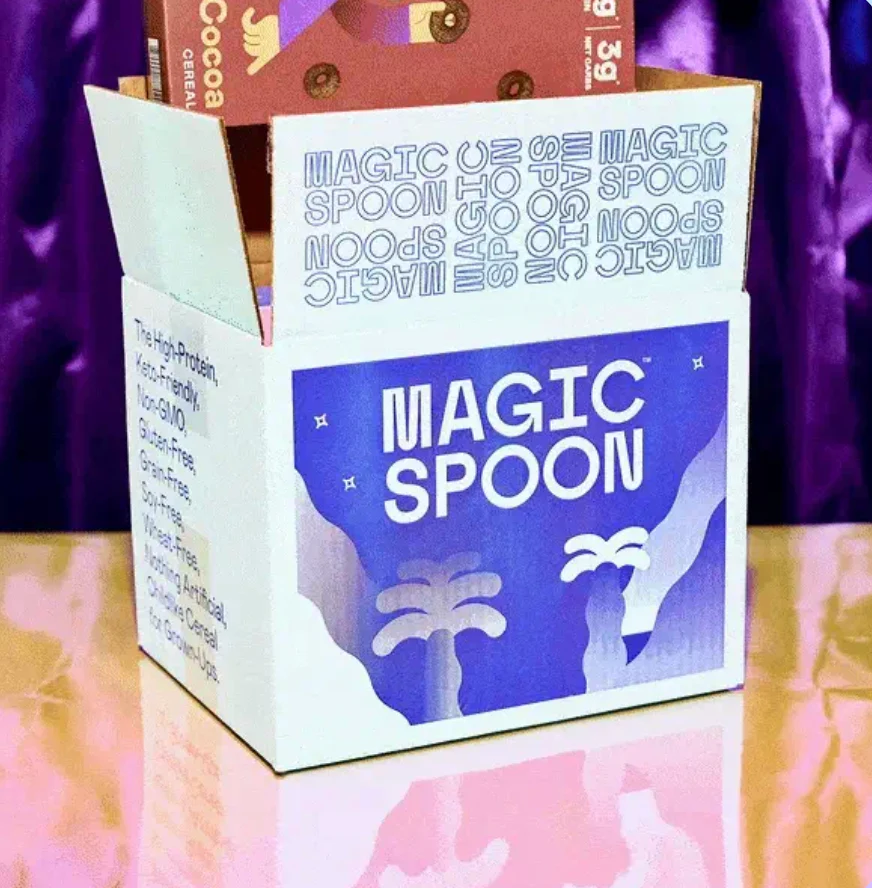
Magic Spoon turns a corrugated shipper into a full brand moment — bold illustrated exterior print and a repeating mirrored logo pattern inside the lid. Strong proof that food packaging doesn't have to default to plain brown.
Magic Spoon made a category-breaking decision: make cereal packaging exciting. The DTC food category defaults to kraft with minimal print because it's cheaper and easier. Magic Spoon went the opposite direction — full-coverage illustrated print on every surface, inside and out — and built a brand that looks as bold as its flavor names. The exterior print is immediate and unmissable. The interior lid pattern (a repeating mirrored Magic Spoon logo) extends the brand moment past the point where most shippers give up. That inside-lid detail costs relatively little per unit at volume but does significant work: it's the first thing you see when you open the box, and it photographs as a strong unboxing moment. For cereal at $39–$45 — a category where $4–$5 is the shelf norm — the packaging has to justify the premium price signal at every touchpoint. Magic Spoon's packaging does that. It tells you before the first bite that this is not grocery store cereal. The sustainability profile of full-coverage print on corrugated is worth monitoring as EPR fees are applied. Print coatings can interfere with curbside recyclability ratings, which affects eco-modulation fee calculations.
Estimates based on mid-volume DTC production runs (5,000–25,000 units). Actual costs vary by supplier, volume, and spec.
| Component | Est. Cost / Unit |
|---|---|
| Corrugated shipper (full exterior + interior lid print) | $4.50–$7.50 |
| Inner product packaging (cereal boxes) | $2.00–$3.50 |
| Estimated total packaging cost | $6.50–$11.00 / unit |